PBL #3
Kerkko Jahnukainen
Problem: How to manage internal operations in a growing company?
Learning Objectives: How do you balance responsibilities between workers and leaders (having the same goal)?
How to build a balanced structure in a growing company
Value chain (Porter)
How does a leader divide responsibilities among employees?
Keywords: Leadership, responsibilities, management, Internal process, growing company, value chain
How do you balance responsibilities between workers and leaders (having the same goal)?
How does a leader divide responsibilities among employees?
An important part of a functional work ecosystem is its interactions between employees, from leaders to workers and vice versa. From this stems trust among each other and from there on responsibility can be handed out to suitable personnel. Leaders need to able to trust their employees with certain responsibilities and not constantly watch over the shoulder as explained in an article on The Guradin website (https://www.theguardian.com/careers/careers-blog/manage-team-how-to) . Giving more space will more likely also lead to better results. Good leader sees the good qualities of its employee and gives its a task best suited for their skill set, making them the most effective at it. Of course, not every employee can be given responsibility, the leader needs to see this as well, but not be too strict. When a task in divided to multiple people it makes everyone job easier. On the other hand some jobs are meant only for management that cannot be handed out and leaders also need to recognize those ones.
On the website www.thoughtleaderslls.com (http://www.thoughtleadersllc.com/2012/09/how-to-find-balance-between-leadership-and-management/) an idea is brought about that says leadership and management are two complementary but still completely different things. This is a quote from the article: "Management is about controlling tasks and creating order in an environment, while leadership is about influencing and motivating staff." Quite an interesting take on the topic, but it does make sense I suppose. Management is to keep a company from falling into chaos and leadership is there to motivate people to do their best. The article explains in a way that says that in a healthy company the employee wants complete the task and not merely finish it.
https://www.theguardian.com/careers/careers-blog/manage-team-how-to
http://www.thoughtleadersllc.com/2012/09/how-to-find-balance-between-leadership-and-management/
How to build a balanced structure in a growing company?
Andy McFarland writes on Knowledge Center website (https://learn.infusionsoft.com/growth/planning-strategy/set-employee-goals-that-grow-your-business) that every employee you ever hire should always add value to the company than it costs you. McFarland suggests using a "Big 3" methods. The way it works is that every time you start thinking about hiring someone for a spot you boil it down to its essence, asking: "What are the top three ways that this position helps your company to achieve its vision?” This may help in not hiring useless people and therefore help keep the balance in the company when everyone has a clear job.
To keep everyone motivated and relevant, communication is needed. It is the key to all. Feedback needs to go both ways. When communication lacks employees lose interest eventually tipping the company into unbalance. When adding new workers the new employees need to be able to merge among the old ones, and no matter how big the company gets, messages need to be delivered from the bottom to top.
Value chain (Porter)
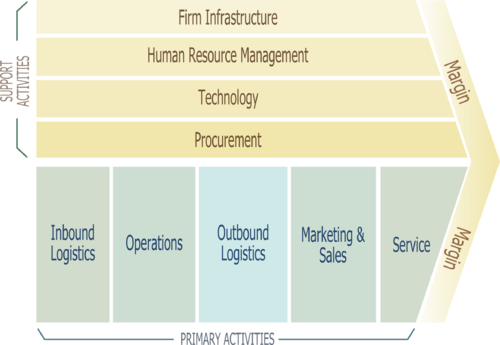
A value chain is as explained by wikipedia (https://en.wikipedia.org/wiki/Value_chain) a set of activities that a company does to deliver valuable product or service to the customers. An idea original described by Michael Porter in 1985. In Porter's value chains, Inbound Logistics, Operations, Outbound Logistics, Marketing and Sales, and Service are categorized as primary activities. Secondary activities include Procurement, Human Resource management, Technological Development and Infrastructure. Value chain can be used as a guideline when trying to map out the future of a company. What parts need to be improved, which added and which ones maybe eliminated? What are the equipment or the people needed to grow the company. All these aspects add up, and disregarding them maybe proof to harmful for the growth of the firm. With a structured approach making the correct moves is much more easily accomplished.
Sources:
https://www.theguardian.com/careers/careers-blog/manage-team-how-to
http://www.thoughtleadersllc.com/2012/09/how-to-find-balance-between-leadership-and-management/
https://learn.infusionsoft.com/growth/planning-strategy/set-employee-goals-that-grow-your-business
https://en.wikipedia.org/wiki/Value_chain

No comments:
Post a Comment